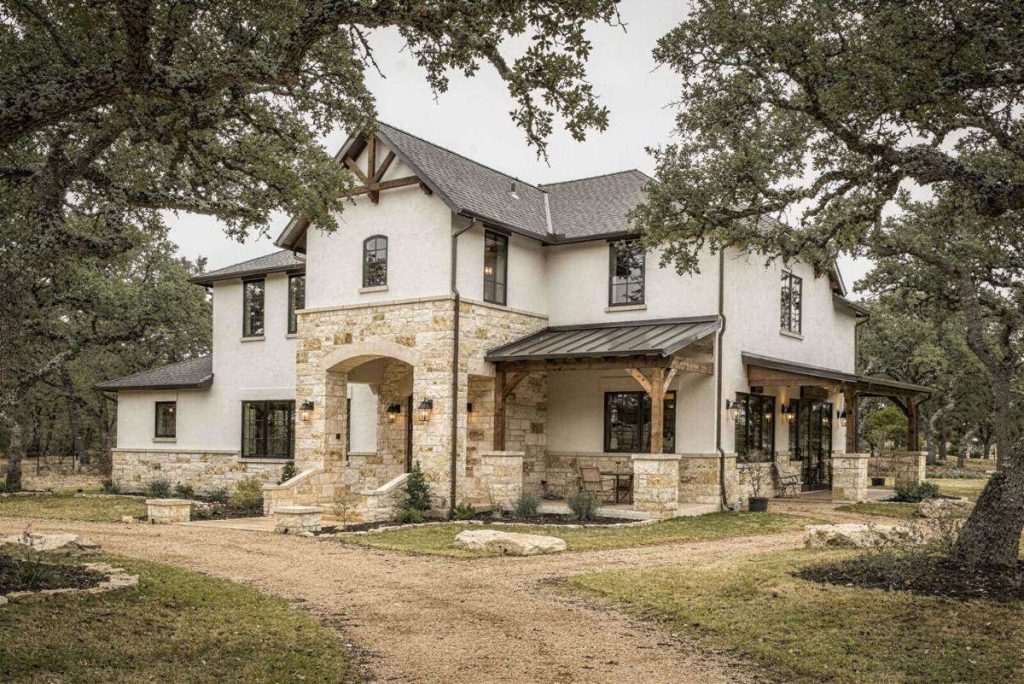
Choosing a stucco color in the Hill Country is a little different from picking paint anywhere else. Your walls sit next to cream and tan limestone, under live oaks and cedar, in strong sun that changes how every shade reads through the day. Many homes also sit in subdivisions with architectural review, so the color you love has to clear an approval process first.
This guide covers color families that tend to work well with local stone and landscape, how sun and heat affect your choice, and how to get HOA or historic review approval without delays.
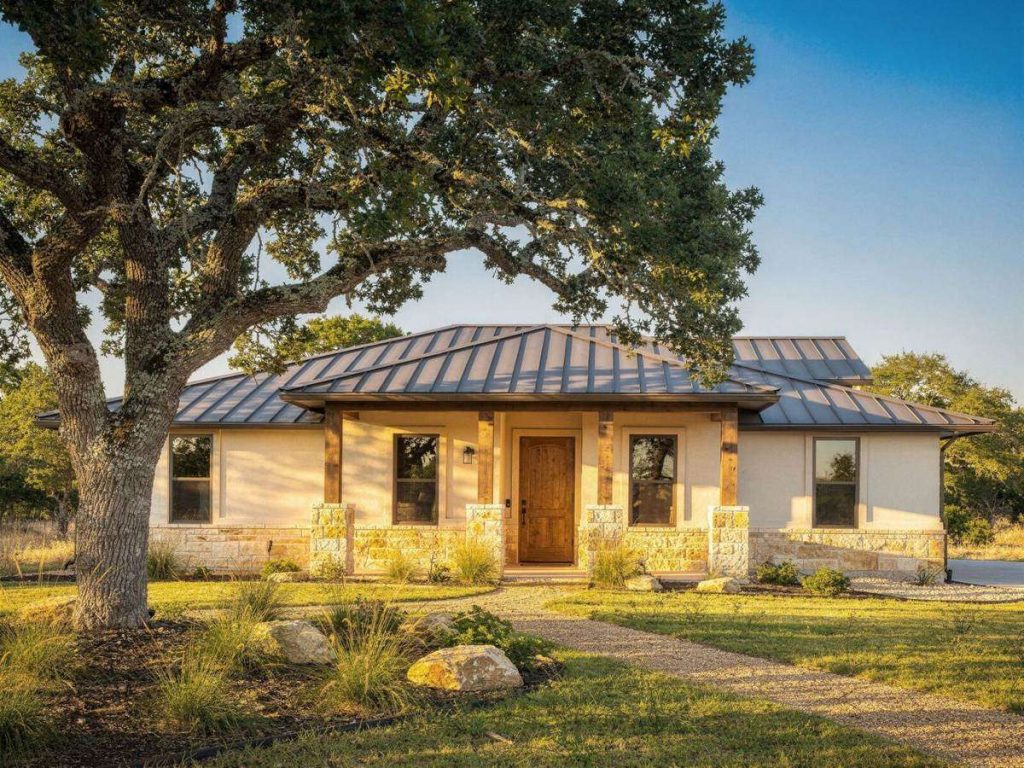
Start With What You Cannot Change
Before looking at swatches, list the fixed elements of your house:
- Stone. Limestone and stone veneer have their own undertones, often cream, buff, gold or gray.
- Roof. Metal, tile and shingle roofs each bring a color you will live with for years.
- Windows and trim. Bronze, black, white or tan window frames shift what works.
- Landscape. Live oak green, native grasses and caliche or gravel drives all show up next to your walls.
The best stucco color usually supports these elements instead of competing with them.
Color Families That Suit the Hill Country
These are starting points, not rules. Always test samples on your own walls.
Warm creams and soft whites
Creams with a hint of yellow or red pair naturally with cream limestone. Pure, cool whites can look stark next to warm stone and can show dust and red soil splash at the base of the wall.
Sand, buff and tan
Mid tone tans and sandy beiges are a common choice on stone and stucco homes because they bridge the color of the stone and the landscape. They also tend to hide dust better than very light colors.
Warm grays and greige
For a more modern look, warm grays and greige (a gray beige blend) can work well with gray toned stone, black windows and metal roofs. Test them in full sun; some grays turn blue or green outdoors.
Muted earth tones
Soft sage, olive, clay and muted terracotta can suit ranch style and Spanish influenced homes. Keep the shade muted so it does not fight with the stone.
Darker accents
Deep browns, charcoals and dark olives often work better as accents on trim, doors or a single feature wall than across a whole house in this climate.
Sun, Heat and Fading
Strong sun affects stucco color in three ways:
- Colors look lighter outside. A swatch that looks right indoors often looks one or two shades lighter on a sunny wall. Many people go a step darker than they first think.
- Darker colors absorb more heat. Paint makers rate colors by light reflectance value (LRV), a scale where black is near 0 and white near 100. Lower LRV colors absorb more sunlight, which can make walls hotter. Some HOAs set limits on how dark exterior colors can be.
- Fading is uneven. South and west walls fade faster. Quality exterior paints and coatings tend to hold color longer, and some deep colors fade more noticeably than others.
Coating choice matters here too. Our post on elastomeric coating vs paint on stucco explains how each option holds up.
How to Test Colors the Right Way
- Narrow your list to two or three colors.
- Paint sample boards at least two feet square, or paint large swatches on the wall itself.
- Look at them in morning, midday and evening light, and on more than one side of the house.
- Place them next to your stone, trim and roof.
- Let samples dry fully; stucco and paint can look darker wet.
- Step back to the street. Color reads differently at a distance.
Getting HOA Approval
Many subdivisions in New Braunfels, Boerne, Bulverde, Kyle and the rest of the region have deed restrictions and an architectural review committee. Requirements vary, but the process usually looks like this:
- Read your HOA documents. Look for approved color lists, rules on body and trim colors, and limits on dark colors or certain finishes.
- Check the approved palette. Some HOAs have a set list. Others approve case by case.
- Submit an application. Most ask for color names and numbers, physical samples or chips, which surfaces get which color, and sometimes photos of the house.
- Wait for written approval before work starts. Starting early can mean repainting at your cost if the color is denied.
- Keep the approval letter with your home records.
Even a repaint in the same color may need a notice or approval in some communities, so check before you schedule.
Historic Review in Fredericksburg and Older Districts
Some Hill Country towns have historic districts with their own review. In Fredericksburg, the city requires a Certificate of Appropriateness from its Historic Review Board for exterior changes to properties in the local historic district and to landmarks. If your home or building is historic, contact the city before choosing colors or starting stucco work.
Matching vs Changing Color
If you are repairing stucco and not changing color, the goal is to blend new work with old. That can be harder than a full color change, because faded walls rarely match the original color. Our guide to matching stucco texture and color explains when a full wall recoat is the cleaner option.
What a Color Change Typically Costs
National cost guides put a stucco recoat or color coat at about $4 to $5 per square foot, with some guides showing a range of $1.50 to $8. Elastomeric coatings run about $1.50 to $5 per square foot, or roughly $3,000 to $8,500 for about 2,000 square feet. These are typical national ranges, not local quotes. Two story walls, stone transitions and tight access tend to push jobs toward the upper end. Crack and patch repair before coating is usually extra. See our stucco repair cost guide.
How Guadalupe Stucco Co. Helps
We look at the condition of your stucco first, since any cracks or water issues need repair before color goes on. Then we talk through coating options, can provide product and color details for your HOA application, and give you a free written estimate with no pressure. Our stucco painting and coating service covers New Braunfels and the Hill Country, including Bulverde and Spring Branch.
FAQ
What stucco color goes best with limestone?
Warm creams, sand and buff tones usually pair well with cream or tan limestone. With gray stone, warm grays and greige can work. Test samples beside the stone in daylight.
Do I need HOA approval to repaint my stucco?
Many HOAs require approval for exterior color changes, and some require it even for a repaint in the same color. Check your deed restrictions and get written approval before work starts.
Are dark stucco colors a bad idea in Texas?
Dark colors absorb more heat and some fade more noticeably in strong sun. Many homeowners use dark shades as accents instead. Some HOAs also limit very dark colors.
Can stucco color be changed without repainting?
If the color is mixed into the stucco, changing it requires a new color coat, paint or coating over the existing stucco.
Planning a new color? Send us a few photos of your home, including the stone and roof, and let us know whether you have an HOA. We will talk through coating options and give you a free written estimate.