EIFS Repair for Hill Country Homes and Commercial Buildings
Synthetic stucco is a foam based system with its own weak points. We confirm what is on your wall, check for moisture where it matters, and rebuild each layer with EIFS materials.

From the curb, EIFS and traditional stucco look almost the same. Knock on the wall and the difference shows. EIFS is a thin, flexible skin over foam insulation, and it needs a different repair than cement stucco. Patch it with the wrong material and the edges tend to crack and let water in.
Guadalupe Stucco Co. repairs EIFS and synthetic stucco on homes, offices and retail buildings across New Braunfels and the surrounding Hill Country. We start by confirming the system and explaining what caused the damage before we put a number on paper.
What EIFS Is
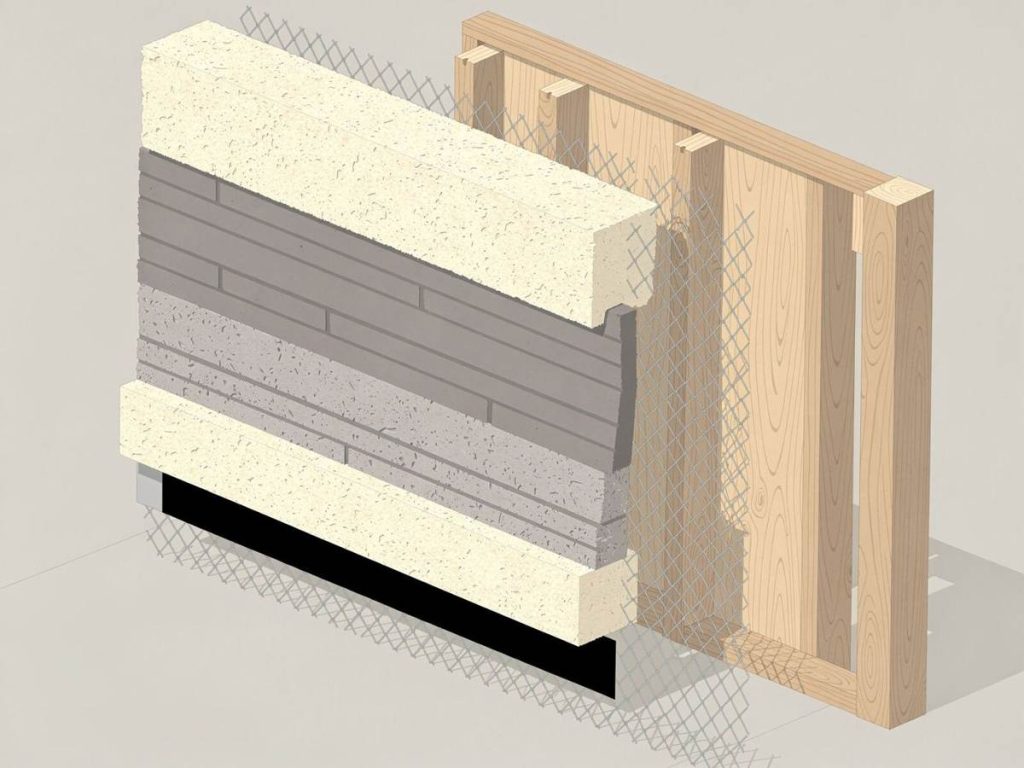
EIFS stands for exterior insulation and finish system. It is often called synthetic stucco, and it is built in thin layers:
- Foam insulation board attached to the wall sheathing with adhesive, fasteners or both.
- Base coat with reinforcing mesh troweled over the foam to give it strength.
- Acrylic finish coat that carries the texture and color.
Newer installations often add a water resistant barrier and a drainage space behind the foam. Older ones frequently do not. That one detail changes how a repair should be approached.
EIFS or Traditional Stucco? Simple Checks
Knowing which system you have is the first step, because the materials and methods are not interchangeable.
- Knock on it. Cement stucco sounds solid and hard. EIFS sounds duller and a little hollow.
- Press with your thumb. EIFS may give slightly under firm pressure. Cement stucco will not.
- Look inside any damage. White or gray foam behind a thin shell means EIFS. Gray cement and wire mesh mean traditional stucco.
- Check the trim. Thick, crisp bands around windows, along rooflines and at column tops are often foam, even on houses with cement stucco walls.
For a deeper comparison, read EIFS vs stucco. Still unsure? Send photos and we will tell you what we see, then confirm on site.
Signs Your EIFS Needs Attention
- Dents, dimples or soft spots after a hailstorm
- Small holes from old screws, birds, insects or mounted fixtures
- Cracked, shrunken or missing sealant around windows, doors, lights and vents
- Bulges or a wavy surface on a wall that should be flat
- Dark streaks running down from window corners or the roofline
- Finish that peels, flakes or rubs off chalky in your hand
- Cracks along foam board seams in a grid like pattern
Why EIFS Fails in Central Texas
Hail and spring storms
Spring storms in Central Texas can bring hail, and EIFS is softer than cement stucco. A hailstorm can leave dimples across a whole side of the house. Dents alone are cosmetic, but when the base coat cracks, water can reach the foam. If storm damage is part of your story, our article on hail damage, stucco and insurance explains what to document.
Sealant breakdown in sun and heat
EIFS relies on sealant joints where it meets windows, doors, hose bibs and roof edges. Long summers and strong UV dry those joints out until they crack or pull away. Those failed joints are among the most common places water gets in.
Wind driven rain and humidity
Heavy rain pushed by wind finds every open joint. On older barrier EIFS, water that gets behind the foam has no designed way out, and Central Texas humidity can slow drying. Damp sheathing can soften or grow mold well before anything shows on the outside. See signs of water damage behind stucco for what to watch for.
Impact at ground level
Mowers, string trimmers, bikes and ladders all bruise the lower few feet of an EIFS wall. Once the mesh is exposed, the damage spreads faster.
Barrier EIFS vs Drainage EIFS
| Feature | Barrier EIFS | Drainage EIFS |
|---|---|---|
| How it handles water | Tries to stop all water at the outer face | Assumes some water gets in and gives it a way out |
| Behind the foam | Foam sits directly on sheathing | A water resistant barrier with a drainage path |
| If a joint fails | Water can stay trapped against the wall | Water has a route to escape |
| Typically found on | Many older homes and commercial buildings | Many newer installations |
We identify the type before we quote. On barrier systems, we check the sheathing at each repair location rather than assuming it is dry.
How We Repair EIFS
Inspect and test
We look at joints, corners, stains and damaged areas and check suspect spots for moisture. You hear what we found and what likely caused it before you get a price.
Cut back to dry, sound material
Damaged finish, base coat and foam come out. If the sheathing is wet or soft, we show you and include replacing it in the written estimate.
Rebuild the layers
New foam is set flush with the wall. Base coat and new mesh go on, lapped onto the surrounding sound surface so the repair ties in.
Match the finish
We match texture and color as closely as the existing finish allows. On faded walls, refinishing the full panel or side of the house often gives the most even result.
Seal and flash
New backer rod and sealant go in at windows, doors and penetrations, and missing flashing is added so the repair has the best chance to hold.
Commercial EIFS
EIFS shows up often on offices, retail centers, medical buildings and apartment complexes along the I 35 corridor and in Hill Country towns. For commercial properties, we can phase work around business hours and provide a written scope that owners and property managers can review. Read more in our guide to commercial stucco repair in the Hill Country.
Related Services
- Stucco water damage and inspection for stains, soft spots and suspected leaks
- Stucco repair for holes and damage in cement stucco
- Stucco crack repair for cracking in traditional stucco
- Stucco painting and elastomeric coating to refresh a faded finish
- Stucco installation and restucco when a wall needs to be rebuilt
More Stucco Services and Guides You’ll Love
What Does EIFS Repair Cost?
National cost guides list EIFS repair at about $30 to $50 per square foot, or roughly $300 to $500 for a small area of about 10 square feet. These are typical national ranges, not our prices. Wet or rotted sheathing, larger areas of finish matching, two story walls and difficult access tend to push jobs toward the upper end. Our stucco repair cost guide explains what drives the price, and a free written estimate gives you the number for your building.
EIFS Repair FAQ
Can EIFS be patched with regular stucco?
- It should not be. Cement stucco is heavy and rigid and moves differently from foam and acrylic finish, so the patch edges tend to crack.
- EIFS repairs call for EIFS base coat, mesh and finish.
Is a hail dent in EIFS a big deal?
- If the surface is not cracked, it is mostly cosmetic. If the base coat is broken, water can reach the foam.
- Photos are usually enough for us to tell you which you have.
Will the repair match the rest of my wall?
- We match texture and color as closely as possible. Sun faded finishes are the hardest to match.
- When a spot repair would stand out, we will say so and price refinishing the full panel as an option.
How can I tell if water is behind my EIFS?
- Stains below windows, bulges and soft spots are warning signs.
- Confirming it takes moisture checks at the suspect areas. See our stucco water damage and inspection page.
Can barrier EIFS be changed to a drainage system?
- Not as part of a small repair. Adding drainage means rebuilding the wall layers.
- If moisture problems keep coming back, ask about restucco and installation.
More questions? Visit our FAQ.
Where We Repair EIFS
We repair EIFS and synthetic stucco in New Braunfels and nearby Hill Country communities, including:
- New Braunfels
- San Marcos
- Kyle
- Buda
- Boerne
- Dripping Springs
- Wimberley
- Canyon Lake
- Bulverde and Spring Branch
- Fredericksburg
See all service areas.
Get Your EIFS Looked At
Prefer to talk? Call us and we will set up a time to look at the damage.